Can I Have Both ADHD and Autism? Yes, It's Called AuDHD
Yes, you can be autistic and have ADHD. Here's how common AuDHD is, why the two can feel like they cancel each other out, why it gets missed, and what to do next.
By Matt · · 8 min read
This article contains affiliate links, marked where they appear. If you buy through one, we may earn a commission at no extra cost to you. Affiliate partners never influence what we recommend. How we handle affiliate links
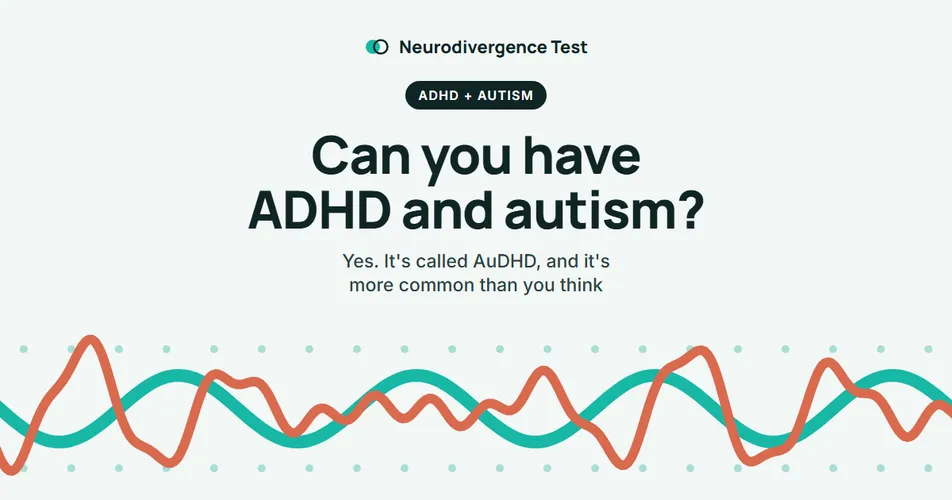
Yes. You can be autistic and have ADHD at the same time, and it’s far more common than most people realise. When both are present, many people use the shorthand AuDHD.
If you’ve spent years feeling like neither label quite fits on its own, this might be why. Craving novelty but falling apart when plans change. Needing routine but never managing to keep one. Bored in seconds, overwhelmed in minutes. Those aren’t contradictions in your personality. They’re often two kinds of wiring sharing one brain.
Our free neurodivergence test screens for ADHD and autism side by side (plus 14 other conditions), so it’s a useful first look if you suspect both.
The short answer
- Yes, both can be diagnosed together. Official rules have allowed it since 2013.
- It’s common. Roughly 3 in 10 autistic people also have ADHD, and some estimates are closer to 4 in 10.
- “AuDHD” is a community word, not a diagnosis. On paper you’d get two diagnoses: ADHD and autism.
Why people used to be told “you can only have one”
For almost two decades, the diagnostic rulebook said you couldn’t have both. The DSM-IV (1994) didn’t allow an ADHD diagnosis in someone who was autistic. Clinicians and researchers worked around it by calling attention and hyperactivity problems in autistic children “ADHD-like”, which helped nobody.
That changed with the DSM-5 in 2013, which dropped the exclusion. The WHO’s ICD-11 later did the same.
This matters if you’re an adult. If you were assessed before 2013, or by someone trained under the old rules, you may have been given one diagnosis when two would have fit better. A lot of people only discover the second half of the picture years later.
How common is AuDHD?
The overlap shows up in both directions, though estimates vary a lot depending on age, setting and how each study defines the conditions.
| Statistic | Figure | Source |
|---|---|---|
| Autistic people who also have ADHD | 28% | Meta-analysis of 96 studies (Lai et al., 2019) |
| Autistic people with ADHD, current / lifetime | 38.5% / 40.2% | Meta-analysis of 63 studies (Rong et al., 2021) |
| Children and teens with ADHD who meet the threshold for autism | 21% | Meta-analysis of 22 studies, about 62,000 young people (Hollingdale et al., 2020) |
Read these as broad ranges, not precise rates. The takeaway is simple: AuDHD is not rare. For more context on how often neurodivergent conditions overlap, see our neurodiversity statistics report.
What AuDHD can feel like
People with AuDHD often describe a tug-of-war. Some traits clash, others stack on top of each other.
Where the traits clash
- Novelty vs. routine. The ADHD side gets bored and wants something new. The autistic side needs predictability and finds change stressful. You might build a careful routine, then abandon it within a week, then feel lost without it.
- Seeking stimulation vs. avoiding it. You might crave noise, movement or intensity one moment and need a dark, silent room the next.
- Spontaneity vs. needing a plan. ADHD impulsivity says yes to the last-minute invitation. Autistic needs say “I didn’t have time to prepare for this.”
- Social energy vs. social cost. ADHD can make you chatty and quick to jump in. Autism can make the unwritten rules of conversation hard to read. The result can be talking a lot, then replaying every word afterwards.
Where the traits stack
- Executive function. Both conditions can affect planning, starting tasks and switching between them. Together, getting out of the house on time can feel like a full workout.
- Sensory sensitivity. Both are linked to sensory differences, so overload can come faster and hit harder.
- Emotional intensity. ADHD often brings quick, strong emotions. Many autistic people find it hard to name what they’re feeling until it’s overwhelming.
- Deep focus. Autistic deep interests and ADHD hyperfocus can combine into hours of total absorption, followed by a crash.
Not everyone with AuDHD feels the push-pull. For some, the traits simply add up. Both experiences are valid.
Signs it might be both, not just one
These are patterns, not a test. But if several sound familiar, it’s worth exploring:
- You have one diagnosis, but it never fully explained you.
- ADHD medication helped with focus, but social exhaustion and sensory overload stayed exactly the same.
- You need structure but can’t stick to it, and both the structure and the lack of it stress you out.
- You’re easily bored and easily overwhelmed.
- Your interests are intense, but some last a lifetime while others burn out in a month.
- You mask constantly, at work and socially, and you crash hard afterwards. If that crash is familiar, read our guide to autistic and ADHD burnout.
If you’re still working out whether autism fits at all, these signs of autism in adults are a good place to start.
Why AuDHD so often gets missed
Each condition can hide the other
This is the big one. ADHD energy and impulsivity can make an autistic person look outgoing and socially confident, so autism gets overlooked. In the other direction, autistic routines and rules can be a clever workaround for ADHD disorganisation, so ADHD stays hidden until life gets too complicated for the system to cope.
Once you have one label, everything gets filed under it
Clinicians call this diagnostic overshadowing. If you’re already diagnosed with ADHD, your social difficulties might be put down to impulsivity. If you’re autistic, your distractibility might be blamed on anxiety or sensory overload.
The old rules
As covered above, many adults were assessed when a dual diagnosis wasn’t allowed.
Masking, especially in women and girls
Many people, particularly women and girls, learn early to copy others and hide their differences. It keeps traits out of sight for years. The signs of ADHD in women show how often this leads to late diagnosis.
How diagnosis works
There’s no single “AuDHD test”. A proper assessment looks at both conditions, ideally with a clinician experienced in each. It usually includes:
- a detailed developmental history, often with input from a parent or someone who knew you as a child
- standardised questionnaires and interviews for ADHD and for autism
- ruling out other explanations, such as anxiety, trauma, depression or sleep problems, which can look similar
Some services assess both in one process. Others assess one condition and refer you on for the other, which can mean two waiting lists.
If you’re preparing to ask for an assessment, write down specific examples from childhood and from daily life now. Screening results can help you start that conversation. Our guide on what to do after a neurodivergence quiz walks through the next steps, and how accurate these quizzes are explains what a screener can and can’t tell you.
Treatment and support for AuDHD
Medication
ADHD medication is commonly prescribed to autistic people with ADHD, and it helps many of them. But the research is thinner than for ADHD alone. A large 2005 trial in autistic children found methylphenidate helped hyperactivity in close to half, but side effects were more frequent than usual. Most studies since have been short and focused on children (NDIS evidence summary).
What that means in practice: a prescriber who understands both conditions matters, and it may take some adjusting to find what works for you.
Strategies built for both brains
Generic productivity advice tends to suit one side and fight the other. What often works better:
- Routine with novelty built in. Keep the structure, but rotate tasks, locations or music within it.
- Plan the unplanned. Leave buffer time in your day so the ADHD side has room to wander without wrecking the autistic need for predictability.
- Body doubling. Working alongside someone else, in person or online, helps many people start and stay on task.
- A sensory kit. Headphones, sunglasses, fidgets, comfortable layers. Treat it as equipment, not a luxury.
- External reminders. Visual timers, alarms and checklists reduce the load on working memory.
- Scheduled recovery. Downtime after social or sensory-heavy events, booked in advance, not just when you collapse.
Therapy
A neurodivergent-affirming therapist can help you make sense of a late diagnosis, untangle anxiety from AuDHD traits, and build systems that fit how you actually work. If finding someone locally is hard, BetterHelp matches you with a licensed therapist online. (That’s an affiliate link, so we may earn a commission at no extra cost to you.)
Is AuDHD its own condition?
Not officially. Clinically, it’s two diagnoses that happen to occur together. But some researchers and many AuDHD people argue the combination is more than the sum of its parts, because the traits interact in ways neither label describes alone.
What is clear is that the two are linked. Large genetic studies show autism and ADHD share part of their genetic risk, which helps explain why they so often turn up together.
The word AuDHD came from the community, not from a diagnostic manual. For many people it’s simply the first word that describes their experience accurately.
FAQ
Is AuDHD a real diagnosis?
No. It’s a widely used community term. You would be diagnosed with ADHD and with autism separately.
Can you be diagnosed with ADHD and autism at the same time?
Yes. Since the DSM-5 in 2013, clinicians can diagnose both together.
Is ADHD on the autism spectrum?
No. They are separate conditions, but they overlap a lot in traits and in who has them.
How common is it to have both?
Studies suggest roughly 28% to 40% of autistic people also have ADHD, and about 21% of children with ADHD meet the threshold for autism.
Can ADHD medication help if you’re also autistic?
It helps many people, but research is more limited and side effects can be more common. Work with a prescriber who knows both conditions.
Bottom line
You can absolutely have both ADHD and autism. If your brain seems to want two opposite things at once, that may not be a contradiction to fix. It may be AuDHD.
Understanding which traits come from where can make everyday life a lot less confusing. Take our free neurodivergence quiz to see how your results look across ADHD, autism and 14 other conditions. It won’t diagnose you, but it can show you what to bring to a professional.