Neurodivergence in Men vs Women: Same Brain, Different Diagnosis
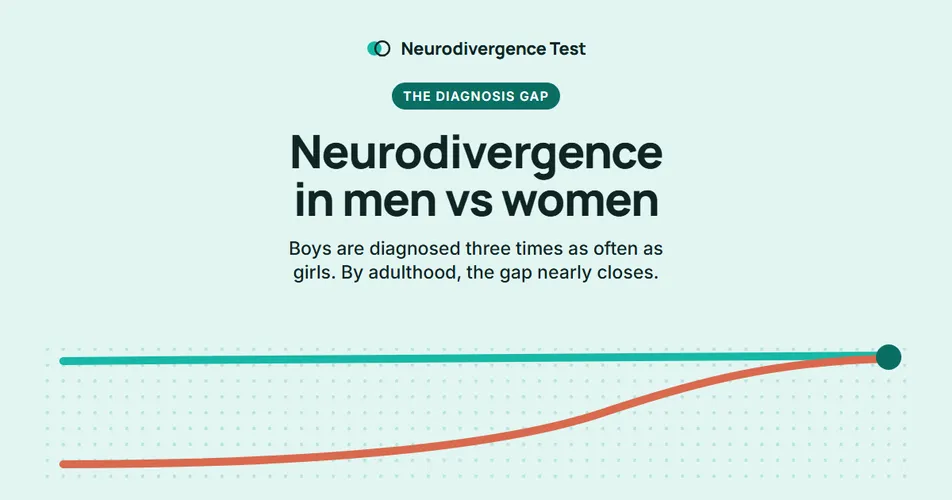
Boys are diagnosed with autism and ADHD about three times as often as girls, yet by adulthood the gap nearly closes. Here is what the research says about why, and what it means for you.
By Matt · · 9 min read
This article contains affiliate links, marked where they appear. If you buy through one, we may earn a commission at no extra cost to you. Affiliate partners never influence what we recommend. How we handle affiliate links
In February 2026, a study in The BMJ followed about 2.7 million people born in Sweden between 1985 and 2020. Among children under ten, boys were diagnosed with autism around three times as often as girls. Then something happened in adolescence: girls and young women were diagnosed in a rush, and by adulthood the numbers were close to equal (Fyfe et al., 2026).
Nobody becomes autistic at 17. What changes is whether anyone notices.
That pattern, a wide gap in childhood that nearly closes in adulthood, is the single most important thing to understand about neurodivergence in men and women. The brains are not as different as the diagnosis rates suggest. The detection is.
This article walks through the numbers, why girls and women get missed, where men lose out too, and what to do if you suspect you were one of the people the system overlooked. If you want a structured place to start, our free neurodivergence test screens for 16 conditions in about six minutes.
The numbers: a gap that shrinks with age
Here is what the gender gap looks like across the most common neurodivergent conditions.
| Condition | Ratio or figure | Who and when | Source |
|---|---|---|---|
| Autism, children | 3.4 boys for every girl (49.2 vs 14.3 per 1,000) | US 8-year-olds, 2022 | CDC |
| Autism, true childhood ratio | Closer to 3:1 than the long-quoted 4:1 | Meta-analysis of 54 studies | Loomes et al., 2017 |
| Autism, adulthood | Near parity between men and women | 2.7 million Swedes born 1985–2020 | Fyfe et al., 2026 |
| ADHD, children | 13% of boys vs 7% of girls diagnosed | US children, 2022–2023 | CDC |
| ADHD, young adults | 3.60% of men vs 2.07% of women with a recorded diagnosis | England, ages 18–24, 2025 | John et al., 2026 |
| Age at autism diagnosis | 15.7 years for females vs 12.3 for males | 171,134 US patients | Messias et al., 2026 |
| Age at ADHD diagnosis | Women about four years later than men (mean 23.5 vs 19.6) | 85,330 people, Stockholm, 2011–2021 | Skoglund et al., 2024 |
| Dyslexia | Boys about twice as likely (9.2% vs 4.7%) | Primary school children worldwide | Yang et al., 2022 |
| Tourette syndrome | Boys about three times as likely | US children, 2016–2017 | CDC |
Two things stand out. First, the gap is real for every condition in childhood. Second, wherever researchers have followed people into adulthood, the gap narrows. Women are not catching a late-onset condition. They are finally being counted.
One widely shared estimate goes further: a 2022 analysis of a single clinic’s records suggested that up to 80% of autistic girls may still be undiagnosed at 18 (McCrossin, 2022). That figure comes from one clinician’s modelling, not a population study, so treat it as a ceiling rather than a fact. The direction, though, matches everything else.
For the broader picture across all conditions, see our neurodiversity statistics report.
Why girls and women get missed
Four things stack on top of each other.
1. The criteria were built from boys
The classic descriptions of autism and ADHD came from studies of boys, and the checklists still carry that fingerprint. A 2012 study of twins found that girls had to show extra problems, such as a lower IQ or disruptive behaviour, before clinicians would give them an autism diagnosis. Boys with the same level of autistic traits got the diagnosis without those extras (Dworzynski et al., 2012).
In plain terms: a quiet, academically capable autistic girl has to be struggling visibly before anyone looks.
2. Masking hides the signs
Masking, or camouflaging, means studying how other people act and copying it: rehearsing conversations, forcing eye contact, laughing at the right moment, suppressing stims. In the largest study of its kind, autistic women scored higher than autistic men on masking and on “assimilation”, the effort of trying to blend in. Among non-autistic adults, there was no gender difference at all, which suggests this is a specific response to being autistic in a world that expects girls to be socially fluent (Hull et al., 2020).
Masking works, in the sense that it keeps you off the radar. It also costs an enormous amount of energy, and it is one of the main drivers of autistic and ADHD burnout.
3. The interests look “normal”
A boy who memorises train timetables gets noticed. A girl who memorises every detail about horses, a band, a book series or human psychology gets called a fan. When researchers compared 69 autistic girls with 69 autistic boys, the girls had fewer and different restricted interests, and their teachers reported far fewer concerns about them, across behaviour and social skills alike (Hiller et al., 2014).
The intensity is the same. The topic is socially acceptable, so it passes.
4. Distress turns inward and gets a different name
Boys with ADHD or autism are more likely to externalise: fidgeting, calling out, fighting, being sent out of class. Girls more often internalise: anxiety, low mood, perfectionism, stomach aches, exhaustion. That matters because internalised distress gets its own diagnosis instead of prompting a search for the cause.
- Roughly a quarter of people treated for eating disorders, overwhelmingly women, score above the cut-off for autism (Westwood & Tchanturia, 2017).
- Autistic women are frequently diagnosed with borderline personality disorder before anyone considers autism, and the two are regularly confused in clinics (Autism in Adulthood, 2025).
- In the Stockholm ADHD study, women had more psychiatric contact, more medication and more self-harm than men in the five years before their ADHD was finally recognised (Skoglund et al., 2024).
Years of treatment for anxiety or depression that never quite works is one of the most common stories we hear. The piece on ADHD in women goes into the day-to-day signs, and the signs of autism in adults covers the autistic side.
Where men lose out too
It would be easy to read all this as “boys get diagnosed, girls don’t”. The reality is less tidy.
Early diagnosis is not always a kind one. Boys who externalise get noticed, but they are often noticed as a behaviour problem first. The label that arrives at seven may be “disruptive” or “lazy”, with the ADHD or autism diagnosis trailing years behind, by which point school has already gone badly.
Quiet boys get missed in the same way quiet girls do. The inattentive boy who daydreams rather than disrupts is overlooked for exactly the reasons girls are. A 1997 review found that children with ADHD who did not act out were less likely to be identified by teachers, whatever their sex (Gaub & Carlson, 1997).
Men’s distress is counted differently. Depression is diagnosed far more often in women. But when researchers added “male-pattern” symptoms to the checklist, such as irritability, anger, risk-taking and substance use, slightly more men than women met the criteria: 26.3% versus 21.9% (Martin et al., 2013). The same irritability and withdrawal in a neurodivergent man can be read as a character flaw rather than a signal.
Masking is not only a female thing. Autistic men mask too, and men who were diagnosed late describe the same exhaustion. The difference is one of degree, not kind.
Beyond “men vs women”
Gender does not come in two boxes, and the research reflects that. In a study of more than 640,000 people, transgender and gender-diverse adults were three to six times more likely to report an autism diagnosis than cisgender adults, and they scored higher on autistic traits even without a diagnosis (Warrier et al., 2020). The authors were careful to say this is an overlap, not a cause in either direction. It does mean that anyone who sits outside the “typical boy” template, for whatever reason, is more likely to be missed.
Biology, bias, or both?
Honest answer: both, and researchers are still working out the proportions.
There is some evidence for a “female protective effect”, the idea that girls may need a higher genetic load before autism shows. There are also real differences in how traits present. But the authors of a major 2023 review in Nature Reviews Neurology concluded that much of what we think we know is muddied by research that conflated sex with gender, measured neither well, and left out women, gender minorities and people with intellectual disability (Bölte et al., 2023). The Swedish finding that the gap nearly vanishes by adulthood suggests that detection, not biology, explains most of it.
What a late diagnosis costs, and what it gives back
The cost is measurable. In the Stockholm data, women were not just diagnosed later; they arrived at the diagnosis with more psychiatric history and more self-harm. Decades of unexplained struggle leave marks: on self-esteem, on careers, on relationships.
The relief is real too. People diagnosed in their 30s, 40s and 50s describe the same moment over and over: a lifetime of “why is this so hard for me” reorganising itself into “oh, that’s why”. Not an excuse, an explanation. Our guide to famous neurodivergent people is full of people who found out late and said exactly that.
What to do if you think you were missed
1. Screen yourself, honestly
Take our free neurodivergence quiz. Answer for your real life, not the version you present at work. The quiz includes optional questions about age and gender, which it uses to adjust scoring for groups where conditions are known to be under-diagnosed. Then read what to do after a neurodivergence quiz.
2. Collect your own evidence
Write down specific examples: the exhaustion after social events, the systems you have built to look organised, the interests you have hidden, the diagnoses that never quite fit. School reports and old friends are useful witnesses.
3. Ask for an assessor who knows the difference
If you seek a formal assessment, ask whether the clinician has experience with adults and with presentations that do not match the childhood stereotype. It is a fair question, and the answer tells you a lot.
4. Get support for the years in between
Whether or not you pursue a diagnosis, a therapist who understands neurodivergence can help you untangle the condition from the shame built up around it. If starting in person feels like too much, BetterHelp matches you with a licensed therapist online. (That’s an affiliate link, so we may earn a commission if you sign up through it, at no extra cost to you.)
FAQ
Are men really more likely to be neurodivergent than women?
In childhood, boys are diagnosed with autism and ADHD roughly three times as often as girls. By adulthood the gap nearly closes, which points to boys being identified earlier rather than being more often affected. Some conditions, such as dyslexia and Tourette syndrome, do show a consistent male excess.
Why are women diagnosed with autism and ADHD so late?
Because the checklists were built on boys, because girls mask more, because their interests look ordinary, and because their distress is usually diagnosed as anxiety, depression, an eating disorder or a personality disorder first. Women are diagnosed with ADHD about four years later than men on average, and with autism about three years later.
Is masking only something women do?
No. Autistic men mask too. Studies find women report more of it on average, especially the “blending in” kind, but late-diagnosed men describe the same exhaustion.
Does neurodivergence look different in men and women?
The traits are the same. What differs is how visible they are, which ones get noticed, and what name they are given. Externalised traits are flagged; internalised ones are treated as something else.
Bottom line
Neurodivergence is not rarer in women. It is harder to see, for reasons that have far more to do with how we look than with how women’s brains work. The same applies to quiet boys, to men whose distress comes out as anger, and to anyone who does not match the template the checklists were drawn from.
If you have spent your life feeling one step out of sync and never knew why, you are allowed to look again, with better information. The free neurodivergence quiz is a reasonable place to start.